
Formation Finance

Call Us:

(03) 9060 7878

Email Us:

info@formationfinance.com.au

Land Loans
Land Loans Australia - Simple land loans to buy your future development site today.

Home - Services - Land Loans

Land Loans in Australia for Development Site Purchase & Land Banking

At Formation Finance, our land loans are tailored to help individuals and developers secure funding for vacant land purchases. Also known as land finance, these loans are typically secured against the land itself and are ideal for bridging the gap between acquisition and the start of construction.

Our flexible land loan solutions turn raw sites into real opportunities. Whether you’re land banking in Sydney’s growth corridors, refinancing a development site on the Gold Coast, or unlocking equity from unused land in Melbourne, we provide up to 75% LVR with loan terms from 3 to 24 months—crafted to suit your project, not constrained by traditional bank criteria.

A land loan is typically the first stage of a broader property development loan strategy, and can be combined with a second mortgage loan to release additional equity for pre-development costs or to bridge between project stages.

Land Loans Quick Snapshot

Key Features Indicative Range
Loan amount $250k – $10M+ (case-by-case)
Term 3 – 24 months
LVR (metro residential) Up to 75% (higher with DA in place)
LVR (rural / regional) Up to 60% (case-by-case, depends on location & marketability)
Interest rate From 8.5% p.a. (subject to LVR, security & exit strategy)
Repayment options Interest-only or capitalised interest (structure varies by deal)
Income verification Not required (asset-backed lending)
Typical timeframe Indicative terms 1–2 business days • Settlement typically 5–10 business days (after valuation & required documents are received)

All figures are indicative only and not an offer of finance. Availability, terms and timing are subject to valuation, security, lender approval, legal/settlement requirements and receipt of required documentation.

What Are Vacant Land Loans

A vacant land loan is a loan secured against vacant land. It is commonly used when a borrower wants to purchase or refinance a site before there is a fixed building contract in place, or when the strategy is to hold the land while planning, zoning, feasibility or timing is being worked through. Depending on the lender and the scenario, land loans may suit borrowers looking at development site acquisition, land banking, refinance of existing vacant land, or early-stage site control ahead of the next funding phase.

How Land Loans Work

Land loans are typically used to purchase or refinance vacant land before construction begins, with the assessment usually focused on the site itself, the proposed loan amount, the borrower structure and the planned exit strategy. In most cases, the lender will review the property details, the intended use of the land, the proposed loan to value ratio, and how the borrower expects to repay, sell or refinance the loan at the end of the term. If the application progresses, it usually moves through valuation, due diligence and formal credit assessment before settlement.

What's the Difference between Bank Land Loans and Private Land Loans:

Banks and private lenders both offer land loans in Australia, but they assess vacant land very differently. Banks typically treat vacant land as a higher-risk security, which means larger deposits, full income verification and, in many cases, a requirement to build within a set timeframe. Private land loans are assessed on the asset and the exit strategy instead, which makes them better suited to developers, land bankers and borrowers who don’t fit standard bank criteria.

 Bank Land LoansPrivate Land Loans (Formation Finance)
Deposit / LVRUsually 20–30% deposit requiredUp to 75% LVR metro (up to 60% rural)
Interest rateLower rates, but strict eligibilityFrom 8.5% p.a., priced on risk & exit
Approval & settlement speedTypically 4–8 weeksIndicative terms in 1–2 days, settlement in 5–10 business days
Income verificationFull income & expense assessment requiredNot required — asset-backed lending
Intention to buildOften required within 2–5 yearsNot required — land banking welcome
Rural / regional landOften restricted by postcode & land sizeConsidered case-by-case, including rural acreage
Best suited forOwner-occupiers building soonDevelopers, investors, land banking, fast settlements

If you have strong income documentation, plan to build shortly and can wait for a longer approval process, a bank land loan may offer a lower rate. If speed, flexibility or a land banking strategy matters more, a private land loan is often the more practical path. All figures are indicative only and subject to valuation, security and lender approval.

When Land Loans May Be Suitable

Development site purchase

A land loan may suit borrowers who need to secure a development site before moving into DA, detailed design or construction finance.

Land banking

A land loan may also suit borrowers who want to hold a strategically located site while waiting for a clearer planning outcome, improved market timing or a later development stage.


Refinance of vacant land

Where a borrower already owns a site, land loans may be used to refinance existing debt, extend holding time or restructure a position ahead of the next stage.


Equity release for pre-development costs

In some cases, equity release against land may help fund early costs such as planning, reports, surveys, consultants or other site preparation expenses, subject to lender assessment.


Vacant land and rural acreage

We also fund vacant land loans for rural and regional sites, including acreage without development plans. Rural land is assessed case-by-case at up to 60% LVR, depending on location and marketability.


How We Assess Land Loans

For land loans, we assess the asset quality and the clarity of the exit strategy. We want to understand how the loan will be repaid and whether the site is marketable within a realistic timeframe.

What we look at

  • Site fundamentals: location, access, shape, services (water/sewer/power), easements

  • Zoning & planning: zoning, overlays, permitted use, subdivision/development potential

  • Deal details: purchase price/valuation, contract terms, settlement timing

  • Security & leverage: proposed LVR, valuation approach, supporting security (if any)

  • Borrower profile: entity structure, relevant experience, overall capacity to execute

  • Exit strategy: sale, refinance after milestones, or next-stage funding pathway

Indicative terms are subject to valuation, due diligence, and final credit approval.
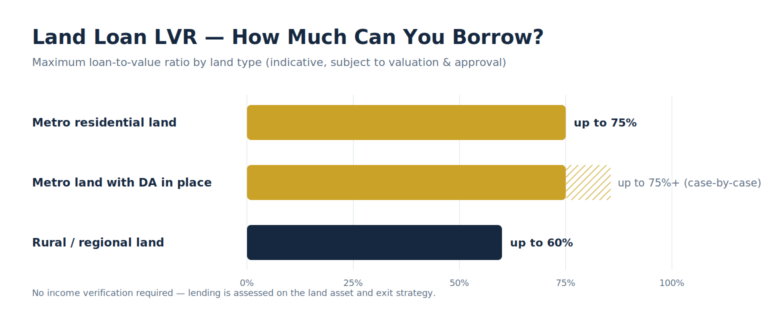
Bar chart comparing maximum land loan LVR in Australia: up to 75% for metro residential land, higher case-by-case with DA in place, and up to 60% for rural and regional land

Land Loans Documents Checklist

Land and transaction details (essentials)

  • Site address and lot/plan (if available)
  • Contract of Sale (or draft contract) and Section 32 / vendor statement (VIC) or equivalent state disclosure
  • Agent listing link (if listed) or purchase details (price, settlement date, special conditions)
  • Recent photos of the site (street view + internal views if accessible)
  • Title search (if available)

Planning and zoning (high-impact)

  • Zoning and overlays (or a council planning link / planning certificate if available)
  • Any existing planning approvals, permits, or correspondence with council
  • If relevant: concept plans, survey, town planner notes, or feasibility summary

Borrower and entity details

  • Borrower name(s) and entity type (individual, company, trust)

  • Directors/trustees details and ID (as required)

  • Current ownership structure and signing authority

  • Brief track record summary (prior projects, if any)

Financial position and exit strategy

  • Short description of the strategy: land banking vs development site vs subdivision intent
  • Exit plan: sale, refinance, or next-stage funding (include expected timing)
  • Statement of assets and liabilities (basic is fine to start)
  • Rental/holding cost assumptions (rates, interest, insurance, etc.) if relevant

Land Loans vs Construction Loans

Land loans and construction loans are related, but they are not the same type of facility.

A land loan is usually used to purchase or refinance vacant land before construction funding is in place. A construction loan is generally used once the project moves into the building stage and the facility is drawn progressively as works are completed.

If the immediate need is to secure a site, a land loan may be the more suitable starting point. If the site is already controlled and the project is ready to move into build phase with plans, approvals, costs and delivery documentation, construction finance may be the more relevant next step.
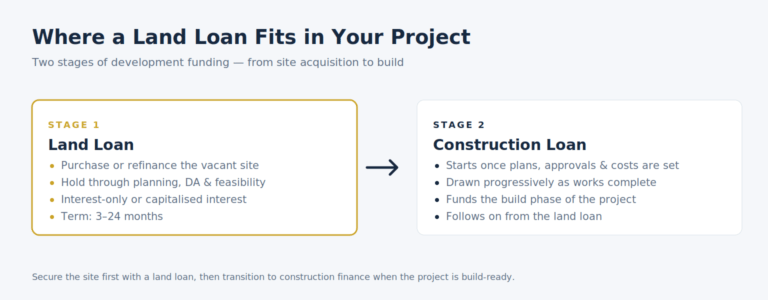
Diagram showing how a land loan funds site acquisition and holding in stage one, before transitioning to a construction loan drawn progressively during the build in stage two

Land Loan Application Timeline: 3 Steps to Secure Land Loans

1. Initial assessment and Indicative Terms (1-2 days)
→ Share property details and loan purpose. Get indicative funding terms at no upfront costs.

2. Obtain final letter of offer (2-5 days)
→ Order valuation report and obtain funding approval.

3. Loan settlement (5-10 days)
→ Finalise loan documentation and receive funds/ property settlement.
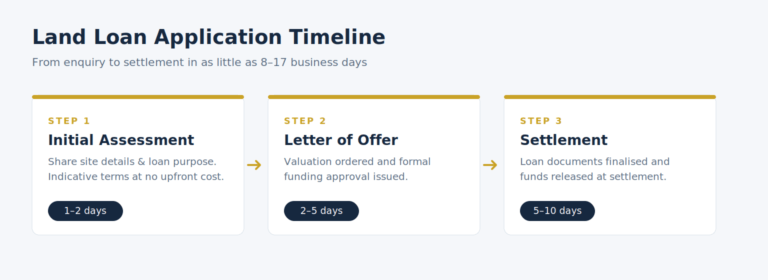
land loan application timeline

Reviewed by Jackie Wang, Partner at Formation Finance

Jackie Wang holds a Master of Professional Accounting from the Royal Melbourne Institute of Technology (RMIT), and has over 10 years of experience in finance and lending, structuring tailored land loan solutions for Australian developers and investors.

Last update: 03/07/2026

Land Loans FAQ:

Timeline for securing land loans from non-bank lenders can range from a few days to a few weeks.

When applying for a land loan, all you need to provide are the property address,  your value estimate (subject to valuation report), loan amount required and loan purpose.

No. No income documentation or expenditure check is required.

Yes! We fund land banking – perfect for holding strategic sites until market conditions improve or rezoning/ Development Approval.

Banks typically require a 20–30% deposit for vacant land. With Formation Finance, we lend up to 75% LVR on metro residential land, meaning a deposit (or equity contribution) of around 25% — and up to 60% LVR on rural or regional land. Existing property equity can also be used to reduce the cash required.

From banks, yes. Vacant land is treated as higher-risk security, so banks apply larger deposits, stricter location and land-size rules, and often a requirement to build. Our land loans are assessed on the land asset and your exit strategy instead, with no income verification, which makes approval more straightforward for developers and investors.